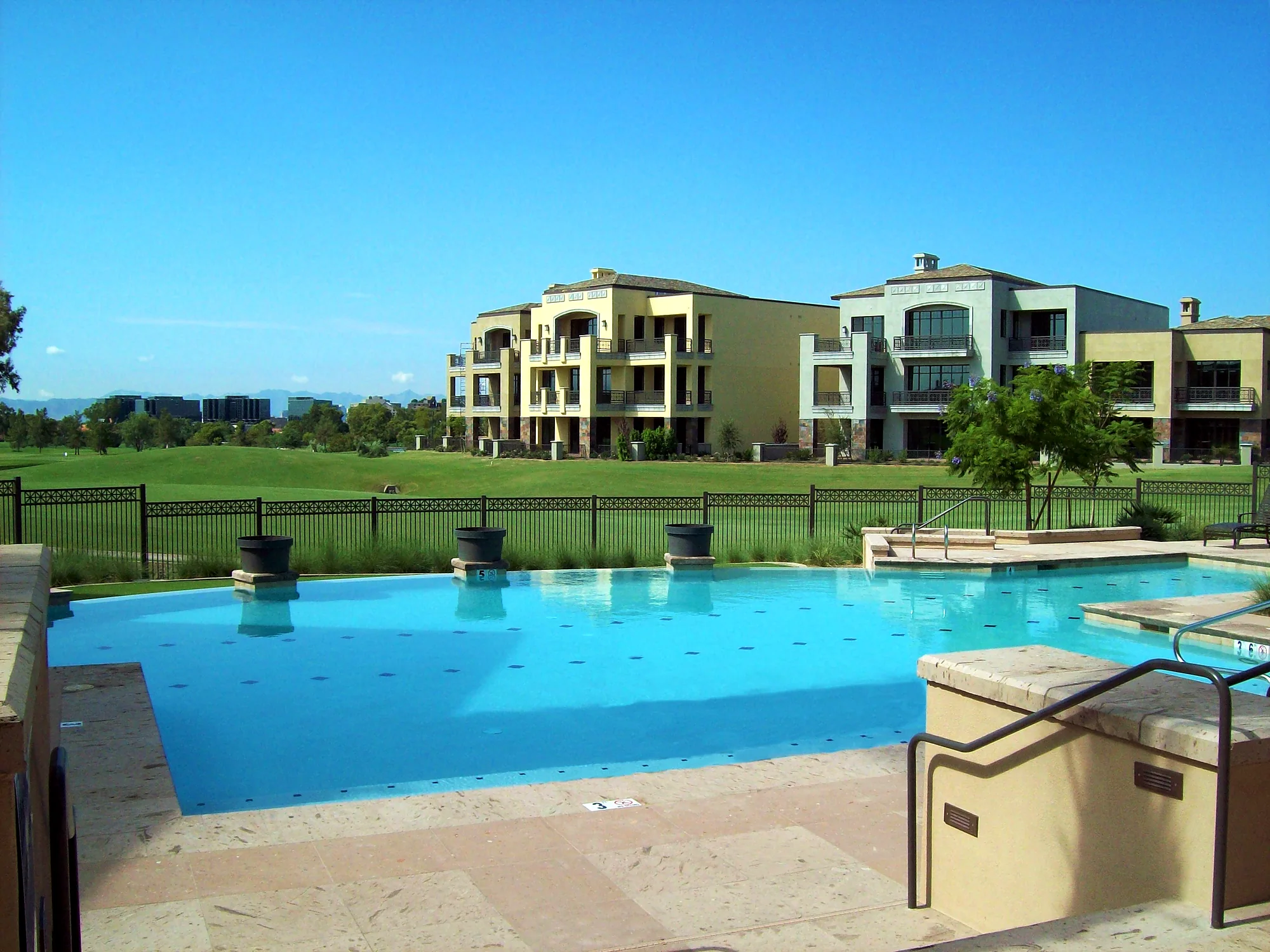
Is your pool public or semipublic?
The county's Aquatic Health & Safety program (part of the Environmental Services Department) regulates public and semipublic pools, spas, wading pools, special use pools and artificial bathing lakes. Private backyard pools do not need an operating permit.
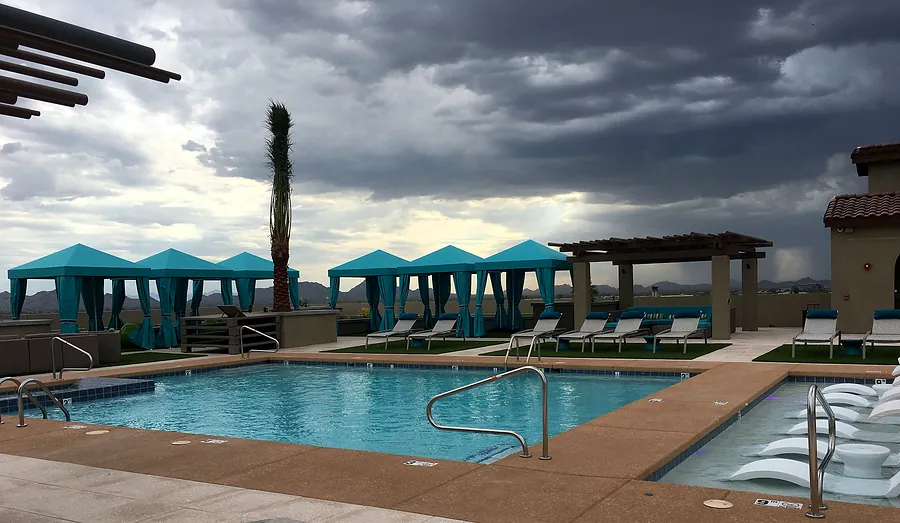
- Semipublic: pools operated for residents of hotels, motels, resorts, apartments, condominiums, townhouse complexes and mobile home parks.
- Also semipublic: pools run by a neighborhood or community association (your HOA) for residents and guests, and country club or camp pools where pool use is part of the main fee.
- Public: pools open to the public, with or without a fee, such as city, school district, university or commercial pools.
The State of Arizona uses the same split in its rules (Arizona Administrative Code Title 18, Chapter 5, Article 2), and the county links to those rules from its program page.
The category matters. Public pools have a few stricter rules, like a 10-foot food and drink buffer instead of 4 feet. If your community starts renting the pool to outside groups, ask the county whether your classification changes.
The permit to operate
No public or semipublic pool may operate in Maricopa County without a valid operating permit. The permit must be posted where people can see it. The county fee schedule lists separate permit categories for bathing pools, spas (hydrotherapy), wading pools and special use pools.
- Permits run one year from the initial issue date and the fee is due on the expiration date.
- Miss the payment and a reinstatement fee applies (the greater of $50 or 5% of the amount due, per the county fee schedule).
- If a permit is revoked or lapses for more than a year, the pool must meet the current code before a new permit is issued.
- A change of ownership needs its own application through the county Permit Center.
| Semipublic permit type | Annual fee (fee schedule rev. 08/19/2026) |
|---|---|
| Bathing pool | $299 |
| Hydrotherapy (spa) | $275 |
| Wading pool | $278 |
| Special use pool | $284 |
Buying an apartment community? Put the pool permit transfer on your closing checklist. It is a lot easier than explaining to residents in July why the gate is locked.
What renovations need county plan review
This is where many boards get surprised. The county requires an Approval To Remodel before you modify a public or semipublic pool in ways that touch safety or sanitation. Yes, that includes a simple replaster.
| Project | County approval needed? |
|---|---|
| New pool or spa | Yes: Approval To Construct |
| Change in shape or depth | Yes: Approval To Remodel |
| Circulation (pumps, piping, filtration) changes | Yes: Approval To Remodel |
| Disinfection system change | Yes: Approval To Remodel |
| Interior resurfacing or deck resurfacing | Yes: Approval To Remodel |
| Water features or planters | Yes: Approval To Remodel |
| Diving equipment | Yes: Approval To Remodel |
| Enclosure (fence, gates, barrier walls) | Yes: fence remodel review |
| Changing semipublic to public use | Yes |
| Fixed ADA pool lift | Yes: simple remodel permit |
| Portable (wheeled) ADA lift, no deck anchors | No permit |
| Lowering or changing gate locks or latches | No plan review (height rules still apply) |
County remodel review fees at the time of writing: $440 for a simple remodel (no below-grade plumbing changes), $606 for a complex remodel (with below-grade plumbing changes) and $482 for a fence remodel. Expedited review is available at two times the fee, but the county does not guarantee a completion date.
New interior finishes must be white, pastel or another light color that does not hide debris, sediment or algae. The county keeps a list of approved non-white colors and non-plaster finishes, and only listed combinations get approved.
Pick your finish from the county's approved color list before you fall in love with it. A dark "lagoon" finish that is not on the list means a variance request, not a quick approval.
How the remodel approval process works
- Plans must be prepared by an Arizona registered engineer or architect, or a licensed pool contractor. New construction requires an ROC A-9, A-19, KA-5 or KA-6 license.
- Submit plans and fees at least 30 days before you need the county to act. Drawings are ANSI D size (24 x 36 inches).
- Construction can start once the approval is issued. Any change to an approved element needs written approval first.
- Piping must stay exposed until the county approves it in writing, so plan your inspections before the deck goes back down.
- When work is done, a contractor, engineer or architect certifies it matches the approved plans.
- A remodeled pool may reopen once the county issues the Approval Of Remodel.
- Approvals expire if work is not substantially complete within one year. An unchanged design can be renewed once.
Supreme Pools & Landscape (AZ ROC #230113) has focused on commercial pools since 1972. We handle county plan review for our commercial projects, with in-house engineering, so the paperwork and the plaster move together. See our commercial pool renovation and pool resurfacing pages for how we run those jobs.
Schedule renovations for the off season and submit early. The county says review time depends on project complexity, how complete the plans are and its current workload.
Daily water quality and records
Water must meet county standards any time the pool is open. These are the main numbers from Chapter VI, Section 2 of the Maricopa County Environmental Health Code.
- Free chlorine: 1.0 to 5.0 ppm (3.0 to 5.0 ppm for hydrotherapy pools).
- Bromine, if used: 2.0 to 4.0 ppm in pools, 3.0 to 5.0 ppm in spas.
- pH: 7.2 to 7.8. Total alkalinity: 60 to 180 ppm. Cyanuric acid: 100 ppm or less.
- Water entering the pool or spa: no hotter than 104 F.
- Clarity: an adult on the deck must be able to clearly see the main drain.
- Test disinfectant, pH, total alkalinity and temperature at least once a day with approved test equipment.
- Keep the operating log for 12 months and show it to the county or the public on request.
For a fecal accident, clear the pool. Solid: remove it, test, and reopen once levels comply. Diarrhea: close for at least 24 hours, shock the water, test 24 hours after shocking, then reopen once levels comply.
If your service vendor tests, make sure the log stays on site. An inspector cannot read a clipboard that lives in someone's truck.
Safety equipment, signs and the pool enclosure
- At least one Coast Guard-approved ring buoy with 50 feet of 1/4-inch rope, and one shepherd's crook on a rigid 16-foot pole, kept ready to use.
- A barrier at least 5 feet high, with no openings that pass a 4-inch sphere and a 3-foot clear area outside it with no footholds.
- Gates open outward from the pool, self-close and self-latch, with a non-key latch at least 54 inches high.
- Pool equipment (filters, disinfection, pumps) protected from tampering by its own enclosure.
- A clearly labeled emergency shut-off switch inside the pool enclosure.
- Posted pool rules, posted maximum bather load, and a no-diving sign or symbol where depth is too shallow for diving.
- No food or drink within 4 feet of a semipublic pool (10 feet for public pools), and no glass in the enclosure.
Required rules signs cover things like no glass, no animals except service animals, keeping gates closed, showering first, swim diapers for incontinent swimmers, and keeping out anyone with an infection or open sores.
Gate locks with keys, keypads or swipe cards have different height rules than plain latches. The county's ADA lift and lock guidance explains both, and changing them does not require plan review.
Inspections and closures
County inspectors can show up during reasonable operating hours without notice. They may review records and equipment and take photos, and the owner or manager can walk along.
The code requires the owner to close the pool if any of these exist:
- No approved disinfectant, or the disinfectant feeder is missing or broken.
- Filtration is not working, or water fails the physical standards (like clarity).
- Main drain or suction outlet covers are broken or missing.
- Gates do not self-close and self-latch, or the enclosure is breached.
- All safety equipment is missing, or required lifeguards are absent.
- A leaking gas chlorinator, electrical wires over the pool, broken glass in the pool area, or any other hazard.
Want a second opinion before the official visit? The county offers advisory or punch-list inspections. Its program page lists $135 per body of water, with at least 72 hours notice and payment in advance.
A broken drain cover in the spa closes the whole pool area if they share an enclosure. Check covers every time the pool is serviced.
Federal rules: VGB drain covers and ADA access
The Virginia Graeme Baker Pool and Spa Safety Act treats pools for residents of an apartment complex or residential development, members of an organization, and hotel guests as public pools. That covers HOA and apartment pools.
- Every public pool and spa must have anti-entrapment drain covers meeting the federal standard (now ANSI/APSP/ICC-16).
- A single main drain that a body could block needs a backup: a safety vacuum release system, suction-limiting vent, gravity drainage system, automatic pump shut-off, or disabling the drain.
- The county advises replacing covers when worn, installed wrong or due per the manufacturer (often about every 5 years), using the same model or one with an equal or higher flow rating.
ADA pool access rules apply to public accommodations like hotels, resorts and swim clubs, and to government pools. Per the Department of Justice, a pool limited to residents of a private residential community and their guests is not covered, but it is covered if the pool is made available to the public for rental or use.
- New or altered pools under 300 linear feet of wall need one accessible entry, which must be a pool lift or sloped entry.
- Pools with 300 or more linear feet need two, and one must be a lift or sloped entry.
- Existing hotel and club pools must remove barriers where readily achievable, usually with a fixed lift.
- Lifts must stay in place and work whenever the pool is open.
Maricopa County does not enforce the ADA, but it does review fixed lifts as a simple remodel to protect walkway clearance (4 feet at semipublic pools). Planning a new amenity deck or rooftop pool? Our commercial pool construction team builds access in from the start.
Sources
Rules change. Always confirm with the agency before you start work. Checked 2026-10-31.
- Maricopa County Aquatic Health & Safety (pool program)
- Maricopa County pool approvals FAQ
- Maricopa County pool projects FAQ
- Maricopa County Environmental Health Code index
- MCEHC Chapter VI, Section 1: General Provisions
- MCEHC Chapter VI, Section 2: Water Quality Standards
- MCEHC Chapter VI, Section 3: General Design Standards
- MCEHC Chapter VI, Section 7: Semipublic Swimming Pools
- MCEHC Chapter I: General Provisions and Fees
- Maricopa County color sample and finish approvals
- Maricopa County ADA lift and lock height guidance
- Maricopa County drain cover safety
- Arizona Administrative Code R18-5, Article 2
- CPSC: Pool and spa drain covers
- Pool and Spa Safety Act, 15 U.S.C. chapter 106
- Pool Safely: VGB Act FAQ
- ADA.gov: Accessible pools requirements
- ADA.gov: Q&A on pool accessibility for public accommodations